
PLC vs SCADA vs DCS: Choose What Actually Fits Your Operations
You’re reviewing proposals, hearing conflicting advice, and still asking:
“Which control system do I need?”
One vendor says DCS. Another says PLC + SCADA.
Meanwhile, timelines slip and the budget stays tight.
This Verdusco Automation article cuts through the noise. It shows you how to identify the leanest, most reliable architecture for your specific floor.
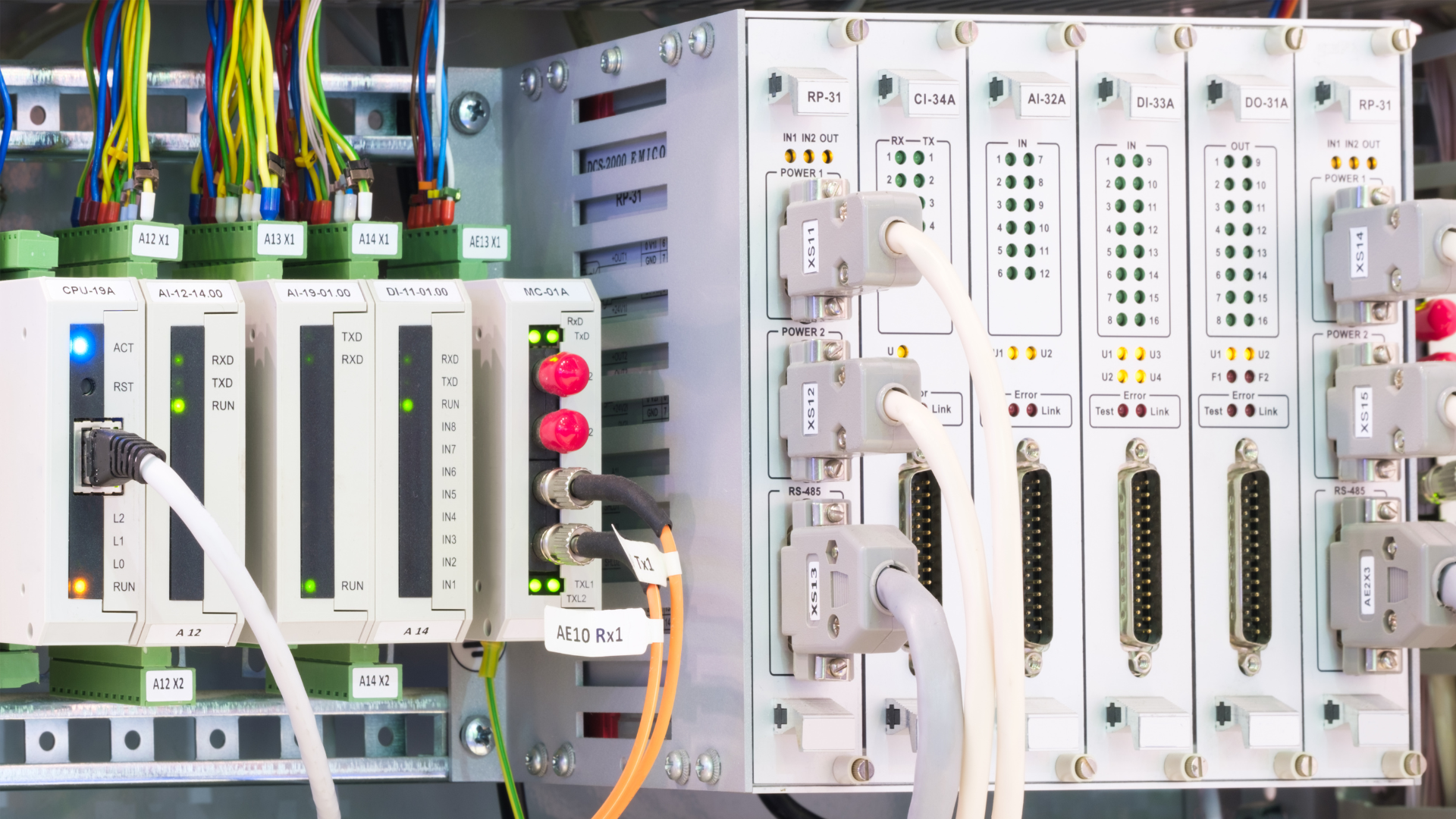
PLC vs SCADA vs DCS: What Each System Is Built to Do
You’re standing on the floor.
A line is down.
An operator flags an issue.
Maintenance gets called.
What happens next depends entirely on how your control system is set up.
Let’s break it down in plain terms.
PLC (Programmable Logic Controller)
The PLC is the machine-level brain. It reads inputs (sensors), makes split-second decisions, and controls outputs (actuators). If a physical action happens, the PLC is responsible.
When you buy from an OEM, the PLC comes pre-programmed with a control logic written by the manufacturer.
In action: In a bottling line, a sensor detects a bottle. The PLC tells a motor to start and a valve to open.
The downside: Control is siloed. Since each machine runs on its own logic, your teams have to ‘plug in’ to machines individually to troubleshoot, rather than seeing the whole line from a single seat.
SCADA (Supervisory Control and Data Acquisition)
Screens, dashboards, alarms, trends. SCADA is about visibility, not control. It offers hardware (a workstation near the line) to interact with the process. SCADA pulls data from multiple PLCs or remote devices.
In action: Instead of walking from station to station, operators can see which alarm triggered first and how performance has trended over the last shift.
The downside: SCADA doesn’t fix problems. It exposes them. If your underlying PLC logic is messy, SCADA just gives you a front-row seat to the chaos.
DCS (Distributed Control System)
DCS is a tightly integrated system where control and visualization are built together. It is used for continuous processes where stability and coordination across many loops matter.
In action: In processes with multivariable interactions, such as temperatures, pressures, and flow rates, instead of separate PLCs stitched together, DCS makes everything a part of one coordinated system. In this space, high redundancy and “never-stop” reliability reign.
The downside: It’s a total commitment. The upfront costs, specialized training, and "vendor lock-in" are significant. You don't "dabble" in DCS.
Hard Truths
Many plants overpay for DCS features they never use.
Others underbuild with PLC-only setups that lack visibility.
This side-by-side comparison shows you exactly where each system fits.
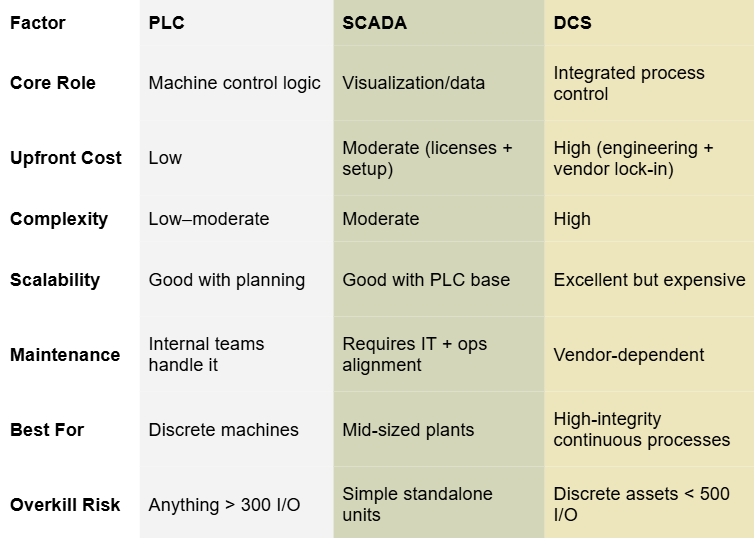
Now that you know what each system does, let’s look at where they actually make sense.
Which Control System Do I Need?
Stop guessing and start matching your architecture to your actual operational needs. Here are three common scenarios where these systems earn their keep.
The PLC-Only Approach
Ideal for equipment that often demands simplicity over connectivity. The PLC-only route keeps your automation lean and localized:
Best for: Standalone packaging machines, simple pump skids, or independent conveyor sections.
The setup: A single PLC handles the logic, paired with a local HMI (touchscreen) for operator control. No servers or complex networking required.
Avoid if: You need to track historical data, generate compliance reports, or monitor the process from a remote office.
The PLC + SCADA Combo
Mid-sized plants typically find their “sweet spot” here. This configuration delivers enterprise-level visibility without the enterprise price tag. In short, it is:
Best for: Food, beverage, and automotive facilities with multiple interconnected lines.
The setup: Individual PLCs manage the food work, while a SCADA layer pulls the data into a central control room for total visibility.
Avoid if: Your process is so highly integrated that a millisecond of lag between the screen and the controller could cause a catastrophic failure.
The DCS Route
Massive facilities where the process simply cannot stop require the "high-integrity" route. This architecture values total stability above all else:
Best for: Large-scale pharma, chemical refining, or oil and gas operations with thousands of I/O points.
The setup: A unified architecture where control and visualization are natively integrated, featuring built-in redundancy and high-level regulatory loops.
Avoid if: You are automating a simple palletizing cell or a bottle-filling line. You will pay for “high-end” features you’ll never touch.
Lock In the Right Control System (and Shut Down Vendor Spin for Good)
When you’re no longer reacting to proposals, you’re driving the decision.
With the right partner, you can:
Challenge overspecified designs.
Align operations, maintenance, and IT early.
Build a system that works now and scales later.
Verdusco Automation supports teams like yours by focusing on what actually works, not what sells.
Here’s what you add to your arsenal:
Control system design and selection → Right-fit PLC, SCADA, or DCS based on your process.
Automation stability and recovery → Fix systems that “kinda work” but keep causing downtime.
Integrated automation solutions → Connect production, material flow, and data into one clear system.
Move Forward
If you’re ready for higher uptime, lower operating cost, and less strain on your team, contact Verdusco Automation through your preferred channel:



Recurring automation failures can quietly drain over $15,000 a year from your plant's budget. Learn how a structured decision tree helps your team decide when to repair, replace, or redesign a failing component and finally break the cycle.