
Should You Keep Chasing Custom Automation… or Is Modular Actually the Smarter, Safer, Faster Play?
You walk the floor. One line runs clean. The other stalls twice before lunch. Corporate wants modernization. Maintenance wants stability. Finance wants predictability.
The pressure sits on you.
This Verdusco Automation article will help you decide when standard is the smarter move and when custom delivers a strategic advantage. No hype. Just a practical filter you can use before signing a PO to future-proof manufacturing lines with flexible automation systems.
Start Here: What Problem Are You Really Solving?
Before debating standard vs. custom, pause.
Stand on the floor for ten minutes without talking. You’ll see it.
The stop-start rhythm of a line that almost keeps up.
An operator nudging a carton into place.
A forklift waiting because downstream is backed up.
Now ask:
Is the constraint mechanical, labor-related, space-related, or process-driven?
Is this a throughput issue or a variability issue?
Are we fixing today’s bottleneck or next year’s forecast?
Many automation projects fail because the problem statement is fuzzy, leading to mismatched deployments. To avoid those outcomes, invest time in a solid requirements‑gathering stage. One that aligns your real operational needs with the right system architecture.
Ask yourself: Does the problem call for a standardized architecture or a fully engineered‑from‑scratch system?
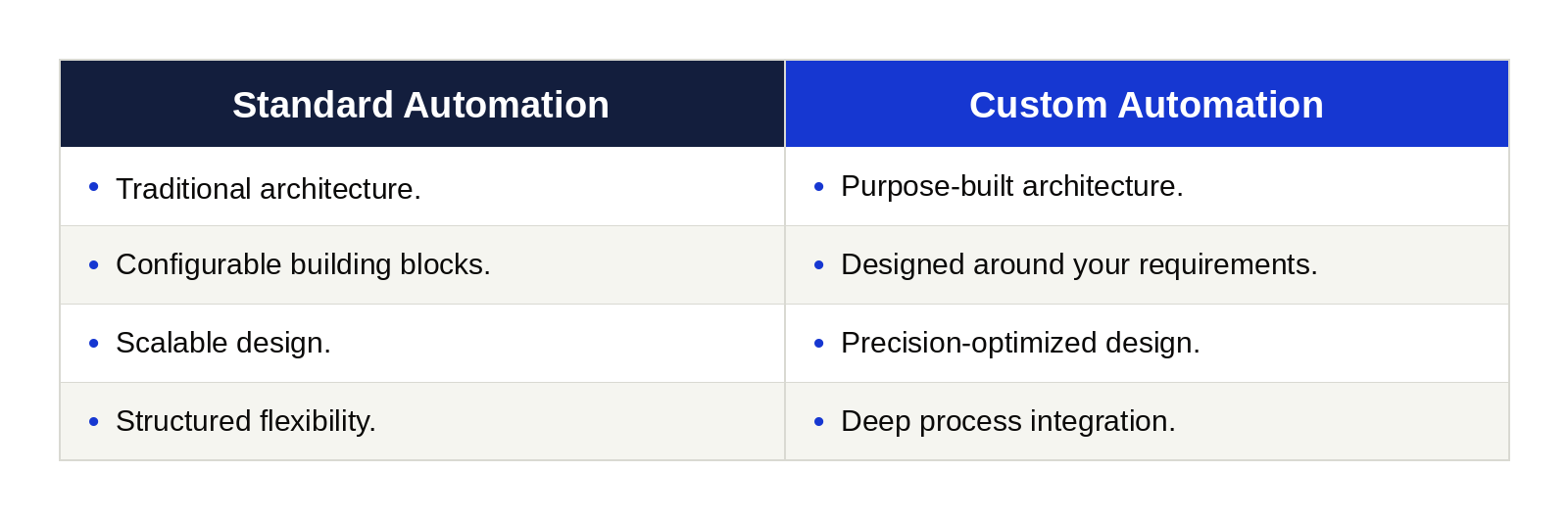
Before asking vendors for designs, write down the constraint in one sentence. If it’s vague, the solution will be too.
When Standard Automation Systems Make More Sense
Most plants aren’t building something revolutionary. They’re moving product, packaging it, inspecting it, and getting it out the door, reliably.
That’s where off-the-shelf automation systems shine.
They’re stronger when:
The task repeats across shifts or plants.
You expect SKU changes.
You need faster deployment.
Downtime tolerance is low.
Maintenance teams need simplicity.
Flexibility does not mean generic. It means configurable.
A modular palletizing cell.
An AMR fleet that scales by adding vehicles.
A conveyor section that can be expanded without rewriting the control logic.
These systems are built on standardized architecture but configured to your footprint and workflow.
Instead of a full line tear-out, you can:
Plan a weekend stop.
Swap a module.
Implement controls familiar to your operators without a weeks-long learning curve.
Maintenance recognizes the components. Spare parts are predictable. Software updates don’t require reinventing the entire system.
Decision filter:
If the function is repeatable, don’t rebuild it from zero. Configure it.
When Custom Automation Is the Right Call
Custom automation makes sense when:
Your process is proprietary.
Product handling is unusual (fragile, irregular, regulated).
Regulatory validation requires unique sequencing or traceability.
Competitive advantage depends on doing something differently.
The ROI supports deeper engineering effort.
In automotive components, for example, complex assembly sequences or torque validation requirements can justify a fully engineered solution.
In pharmaceutical environments, validation protocols often demand a tailored control architecture.
When executed properly, custom automation feels precise and deliberate. But it comes with trade-offs:
Longer engineering cycles.
Greater integration complexity.
Higher dependency on the original vendor.
Future modifications that cost more than expected. This is where plants get nervous. Not because custom is wrong, but because the lifecycle and long-term support can be underestimated.
Decision filter:
If your edge truly depends on uniqueness, invest in custom. Just go in with eyes open.
Future-Proof Manufacturing Lines with Flexible Automation Systems
The real win isn’t choosing sides. It’s designing a manufacturing line with intention.
A future-proof strategy:
Separates core proprietary processes from adaptable modules.
Avoids locking hardware and software so tightly that upgrades become painful.
Plans expansion paths before the first install.
Evaluates total lifecycle cost, not just install price.
And that’s where your automation approach truly differentiates outcomes:
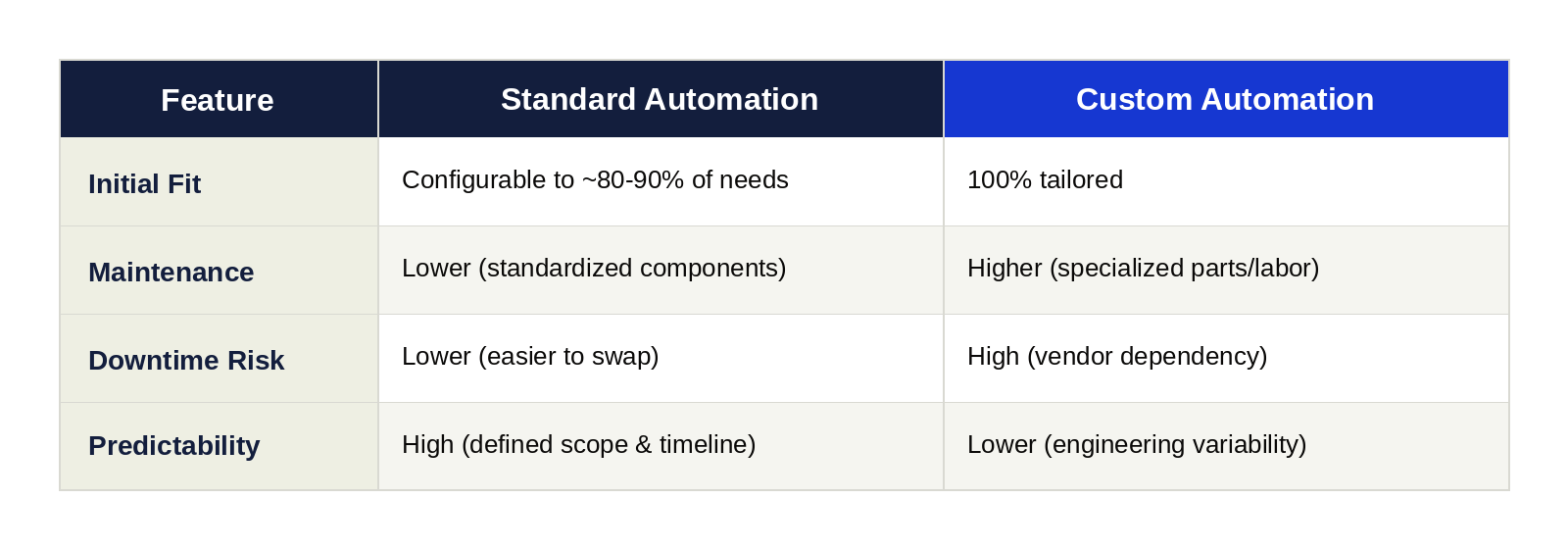
We see it frequently in manufacturing:
In practice, the strongest automation strategies combine both approaches.
A plant may keep its proprietary processing stage custom while deploying modular material handling or autonomous mobile robots to manage internal transport.
In that model, adding a new SKU becomes a configuration change, not a capital crisis.
That’s where the right integration partner matters.
At Verdusco Automation, we help plants make these calls without overengineering or overspending. Our work focuses on practical results:
Integrated automation solutions that blend modular and custom systems into one coherent architecture.
Scalable PLC and HMI platforms designed for long-term flexibility.
Autonomous mobile robots (AMRs) and modular intralogistics systems that reduce forklift traffic and operator fatigue.
If you’re weighing standard vs. custom and want clarity before committing, let’s talk.
Contact Verdusco Automation at:
📩: maria@verduscoautomation.com.
LinkedIn: Raul Verdusco
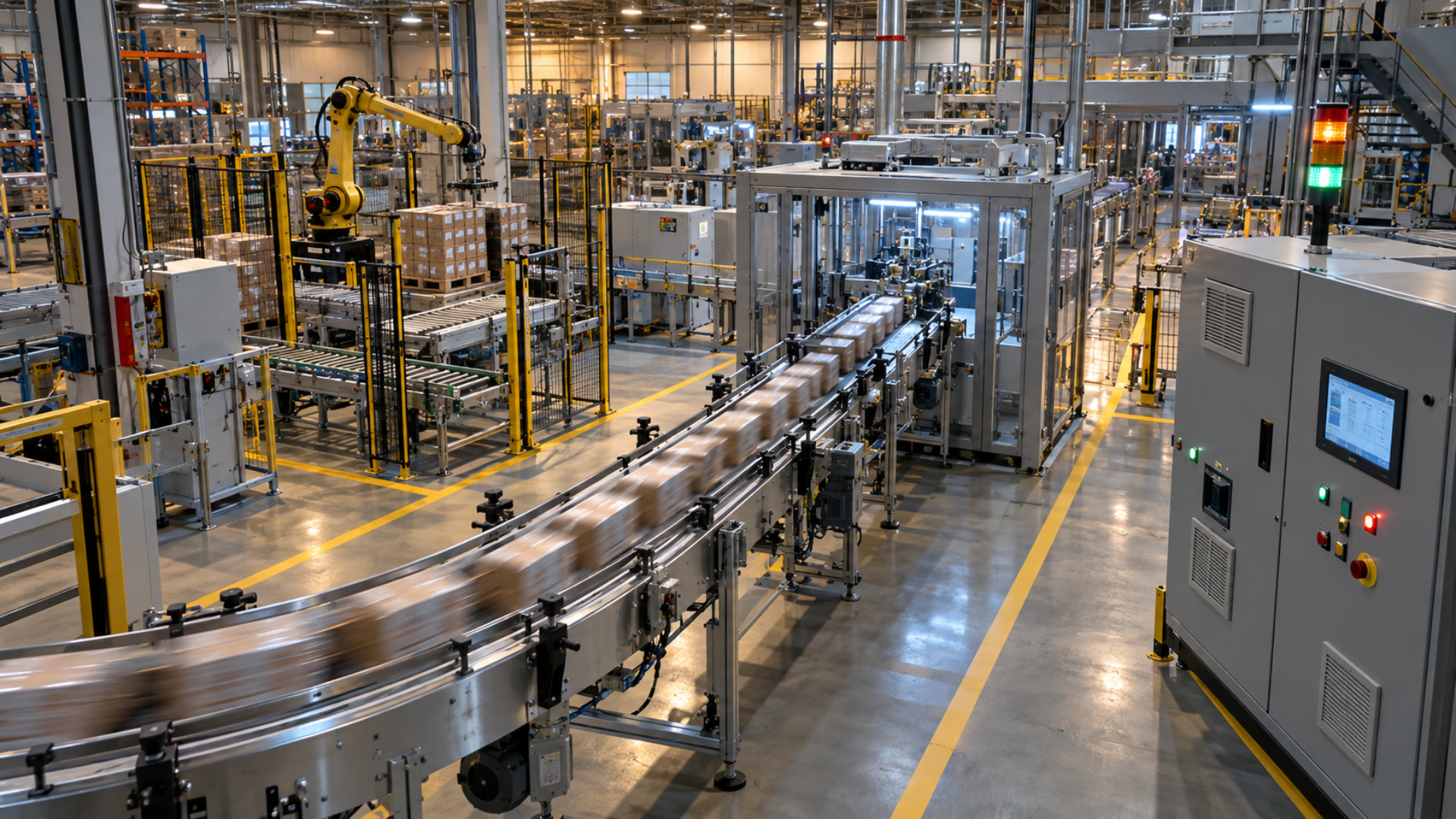

Aging conveyors don't always need full replacement — often the mechanical structure is sound and only the controls are outdated. Discover how a control system retrofit with VFD motor control and smart sensors can cut downtime, reduce damage, and deliver payback in months.