
Why Do Your ‘Off’ Hours Still Cost Like Full Production?
You slow production for a shift change or a jam on the line, yet the electricity meter barely reacts.
Compressors keep pushing air.
Boilers hold pressure.
The bill looks the same whether your line runs at 100% or 40%.
This Verdusco Automation article breaks down why that happens and shows how connecting utilities to real production demand helps manufacturers finally stop paying for “ghost load.”
If you want to eliminate equipment idling waste and start gaining energy savings in manufacturing, sit tight and read along.

When Production Slows, but Utilities Don’t
Walk through any plant during a slow shift. You’ll notice the same pattern.
Half the packaging stations are idle.
A palletizer waits for the upstream line to recover.
Operators stand nearby, clearing a jam or preparing for the next run.
Yet the utility room tells a different story.
The compressors are still running hard.
The pressure gauge sits steady as if production never slowed down.
The electric meter outside keeps spinning at the same pace it did during peak throughput.
No one questions it because this is how utilities have always been managed.
Most compressors and boilers operate on fixed logic. They maintain pressure or temperature no matter what the production floor is actually doing. So when output drops during a jam, a lunch break, or a shift change, the utilities keep running exactly the same way.
Over time, that mismatch becomes invisible. It feels normal. But it’s not.
It’s an idle waste. And it’s expensive.
Solving the Problem Without New Compressors, New Boilers, or a Major Overhaul
Many facilities still rely on manual oversight or fixed control loops. Operators decide when to reduce utilities load. In practice, they rarely do, because later it can disrupt production.
Instead of replacing equipment, what needs to change is how utilities respond to production signals. A simple fix is a lead-lag automation script. The system automatically adjusts utilities based on what the line is producing.
Here’s how the lead–lag script plays on the floor:
The packaging counter at the end of the line measures throughput. When production slows (because of a jam, shift change, or short stoppage), the counter stops advancing.
An IIoT gateway listens to that signal. It then communicates with the compressor VFDs through the lead-lag control script. The lead compressor gradually reduces output. The lag compressor remains in standby.
When production ramps up again, the system reverses the sequence and restores full pressure smoothly.
Operators don’t have to touch anything.
When production resumes, pressure builds steadily without the scramble of manual restarts. Utilities finally respond to real demand instead of guessing it. And your electricity bill takes a bow.
Energy Savings in Manufacturing: What Happens When You Eliminate Equipment Idling Waste
The financial payoff of syncing utilities to demand is immediate.
Instead of treating utilities as either fully on or fully off, the system adjusts output to match what the line actually needs.
Here’s what operators lived with before and what changes after implementing a lead-lag script:
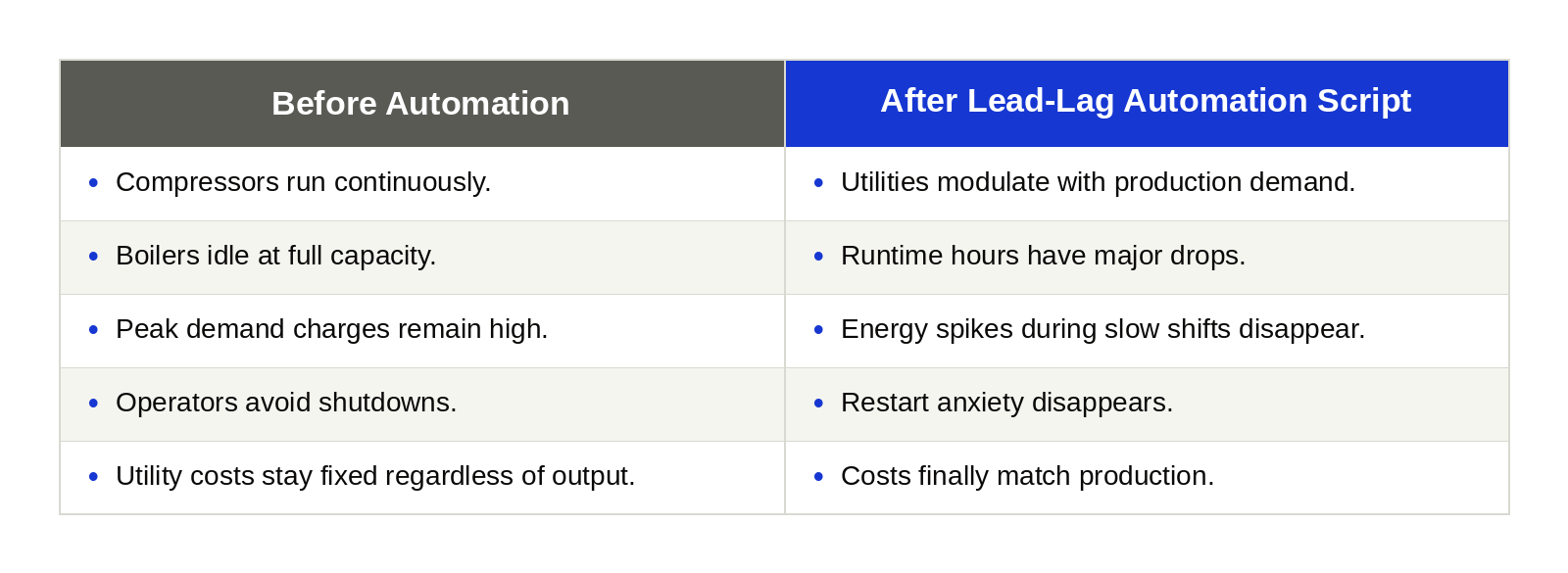
In a plant where equipment sits idle 30–40% of the time, a lead-lag control strategy removes a large portion of that wasted runtime.
For many facilities, this translates into five-figure annual energy savings.
In larger plants, even a 15–20% reduction in utility waste can free up $7,500 to $10,000 per month, or up to $120,000 per year.
For the first time, energy costs start matching real production output.
How to Repurpose Your Utility Room
True evolution in manufacturing doesn’t have to be a multi-million dollar “smart factory” overhaul.
Sometimes the biggest improvements come from linking systems that were never designed to talk to each other.
When you:
Connect production counters to utility systems.
Upgrade legacy compressors with smart controls.
Automate lead-lag load balancing.
Use real production data to guide utility response.
…your plant starts behaving the way it should:
Utilities react instantly to real conditions instead of hours later.
The mechanical room stops blasting at full load.
Pressure stays steady during ramp-up.
Energy bills finally reflect actual production.
Whether it is connecting production signals to compressors, boilers, and VFDs, capturing real production data to guide utility response, or designing lead-lag control strategies for utilities and production lines, Verdusco Automation helps you implement these practical upgrades.
Start with one production line, one compressor, and one automation change at a time and watch your distress turn into confidence.
Ready to act?
Contact Verdusco Automation through your preferred channel:
📩: maria@verduscoautomation.com
🔗: https://www.linkedin.com/in/raul-automation/
🌐: https://www.verduscoautomation.com/contact
_________
Final Note: This article illustrates what’s possible. But since every facility is different, a custom analysis is always needed for diagnostic, ROI, and deployment purposes.

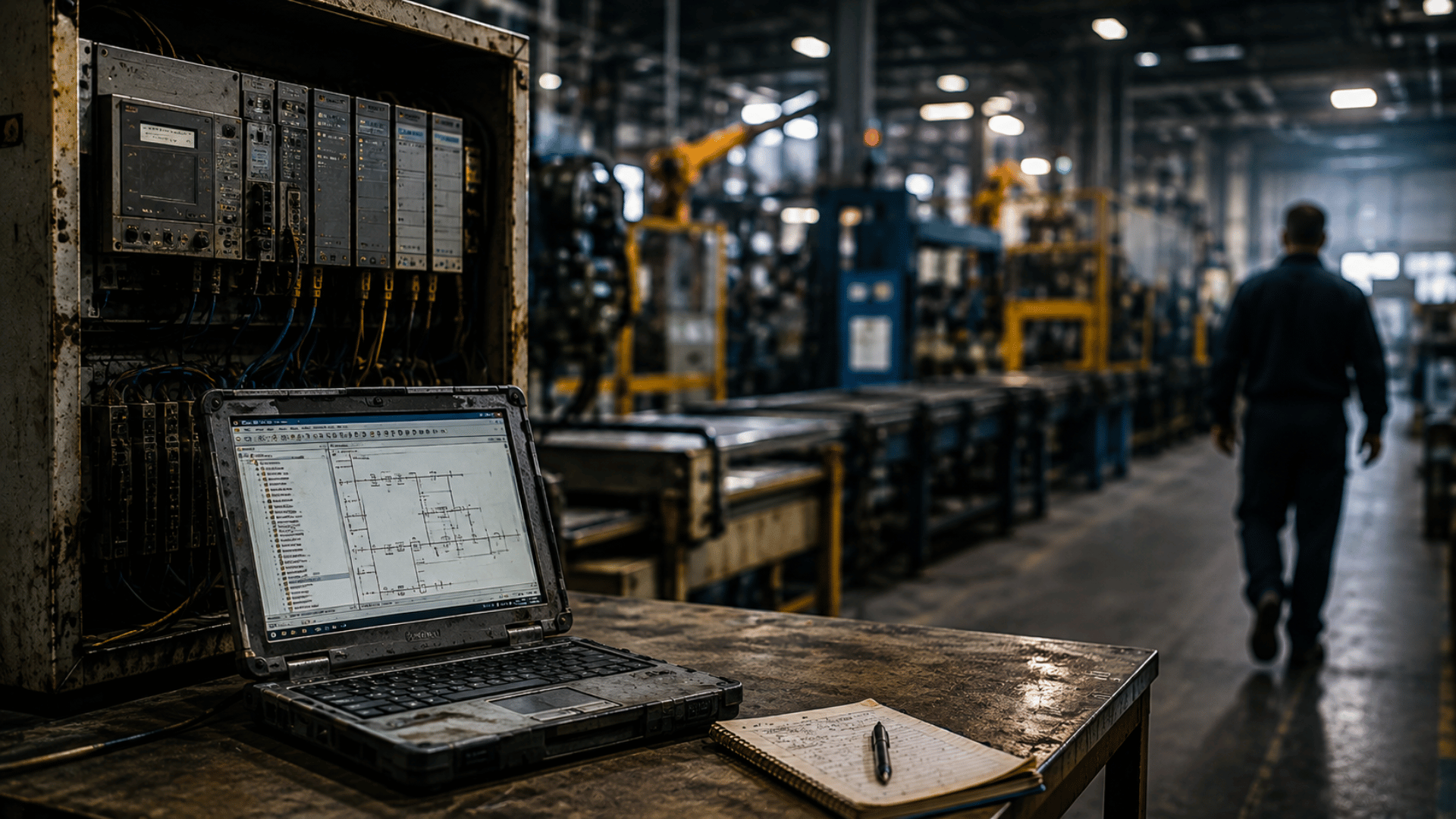

Learn how to prevent PLC integration failures by auditing legacy controls, verifying communication requirements, and identifying risks before equipment arrives, helping keep your manufacturing automation project on schedule and avoid costly commissioning delays.