
3 Defense Supply Chain Problems Solved by AMRs and AGVs
Defense supply chain teams know the pressure:
Balancing speed, compliance, and cost with systems that barely keep up.
The result? Missed picks, delayed shipments, and rising labor strain become the norm instead of rare events.
This Verdusco Automation article outlines how autonomous mobile robots (AMRs) and automated guided vehicles (AGVs) stabilize defense logistics so operations move forward with full confidence and zero guesswork.

Removing Defense Supply Chain Frictions with AMRs and AGVs
In defense logistics, reliability is the only currency that matters. To achieve it, supply chain teams are starting to rely on automation to improve inventory visibility and strengthen readiness, so the right material moves at the right time, even when disruptions hit.
Two technologies are leading this shift:
Autonomous Mobile Robots: Unlike traditional belts, AMRs use onboard sensors to navigate. If a pallet is left in an aisle, the robot finds a new path. They adapt to your existing floor plan without the need for magnetic tape or wires.
Automated Guided Vehicles: These are the workhorses for heavy, repetitive hauls. If you have high-volume lanes where materials move predictably, AGVs provide the steady, repeatable cadence that manual transport lacks.
Both systems integrate with existing PLC and ERP software. When a robot moves a part, the inventory updates in real-time. No clipboards. No lag. No guessing.
While many facilities are transitioning fully to AMRs, the most efficient Industry 4.0 operations take a hybrid approach, using AGVs for fixed, heavy-duty hauls and AMRs for dynamic, flexible tasks.
Main Problems Solved by AMRs and AGVs
1. Eliminate Delayed Material Movement
In defense logistics, timing is not a performance metric. It’s a requirement. Yet in many facilities, operators spend 10 miles per shift walking materials across the floor. Every delay in transit slows production and creates downstream risk. Assembly lines wait. Workcells stall. High-priority orders lose momentum.
With AMRs and AGVs, material flow becomes continuous and predictable. Parts arrive exactly when needed, without relying on manual transport availability. The impact is immediate:
Faster response to production demand.
Fewer transport-related delays.
Consistent material delivery across the floor.
Here’s a case study about how the integration of AMRs with automated shelving empowered big improvements in materials ordering, quality control, and assembly.
2. Decrease Near-Miss Safety Incidents
Logistics operations carried out in cramped quarters with narrow aisles and heavy machinery make manual material handling dangerous. Integrating AMRs and AGVs eliminates “near-miss” accidents by:
Automating pick-and-place to remove the human element from the highest-risk activity, which is the manipulation of heavy components.
Creating forklift-free zones in high-density areas to reduce collision potential and eliminate the need for additional material handlers in hazardous zones.
Enforcing strict, pre-programmed safety protocols, such as slowing at intersections and stopping instantly for obstacles, to reduce the risks of speeding or distraction-related errors.
Want proof? See this case study.
3. Increase Logistic Capacity with Robotics Flexibility
Unlike manually operated forklifts or tuggers, AMRs and AGVs enable an infrastructure-independent environment where routes and processes evolve in real-time. This flexibility allows you to:
Scale fleets based on current contract demand.
Adjust routes in minutes, not days.
Optimize paths mid-shift without downtime.
By removing the previous rigidity of fixed paths, you directly increase overall production capacity.
Check out this real-world success story of an actual deployment.
What the ROI Looks Like: Before vs. After AMRs and AGVs Deployment
You need numbers before presenting to the board. So, here is the math from a single workcell.
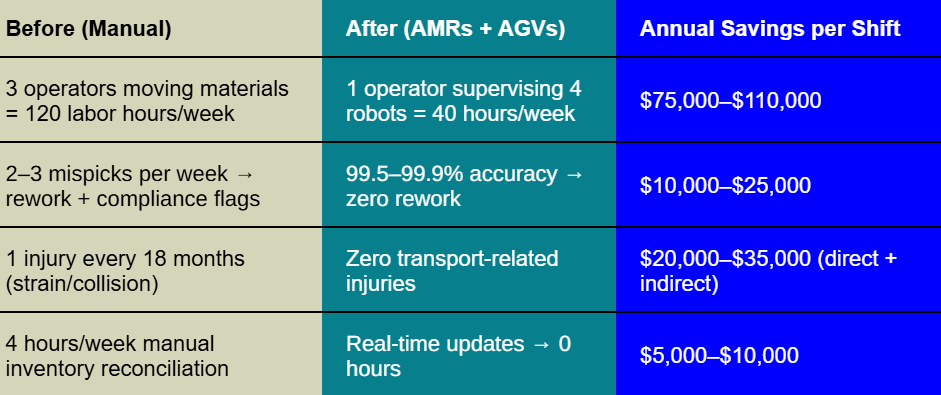
Total estimated savings (per workcell, per shift): $115,000–$180,000 annually
Most AMRs and AGVs deployments for a single workcell range from $120,000 to $250,000, depending on fleet size, integration complexity, and facility layout. The typical payback period is 12–24 months. You’ll see faster ROI when scaled across multiple shifts or zones.
How a Specialized Automation Integrator for Government Contracts Supports You
Adopting automation doesn’t require you to figure it out alone.
A specialized automation integrator for government contracts understands both the technical and regulatory sides of your operation. That’s where Verdusco Automation comes in.
We partner with your team to design solutions that fit your facility, not force your facility to fit the technology.
Here’s how we support your transition:
AMR and AGV system integration: From layout design to deployment, ensuring robots work seamlessly with your existing workflows.
Control systems and PLC integration: Connecting robots with your current infrastructure for real-time decision-making and visibility.
Industrial automation design: Building rugged, scalable systems that meet defense standards without overcomplicating operations.
The goal is simple: help you move faster, operate safer, and compete stronger, without adding unnecessary complexity.
Contact Verdusco Automation today to start your assessment:
📩: maria@verduscoautomation.com
___________
Final Note: The figures above illustrate the potential for optimization. Every facility has unique variables. A custom analysis of your floor is required for a precise ROI calculation and implementation plan.
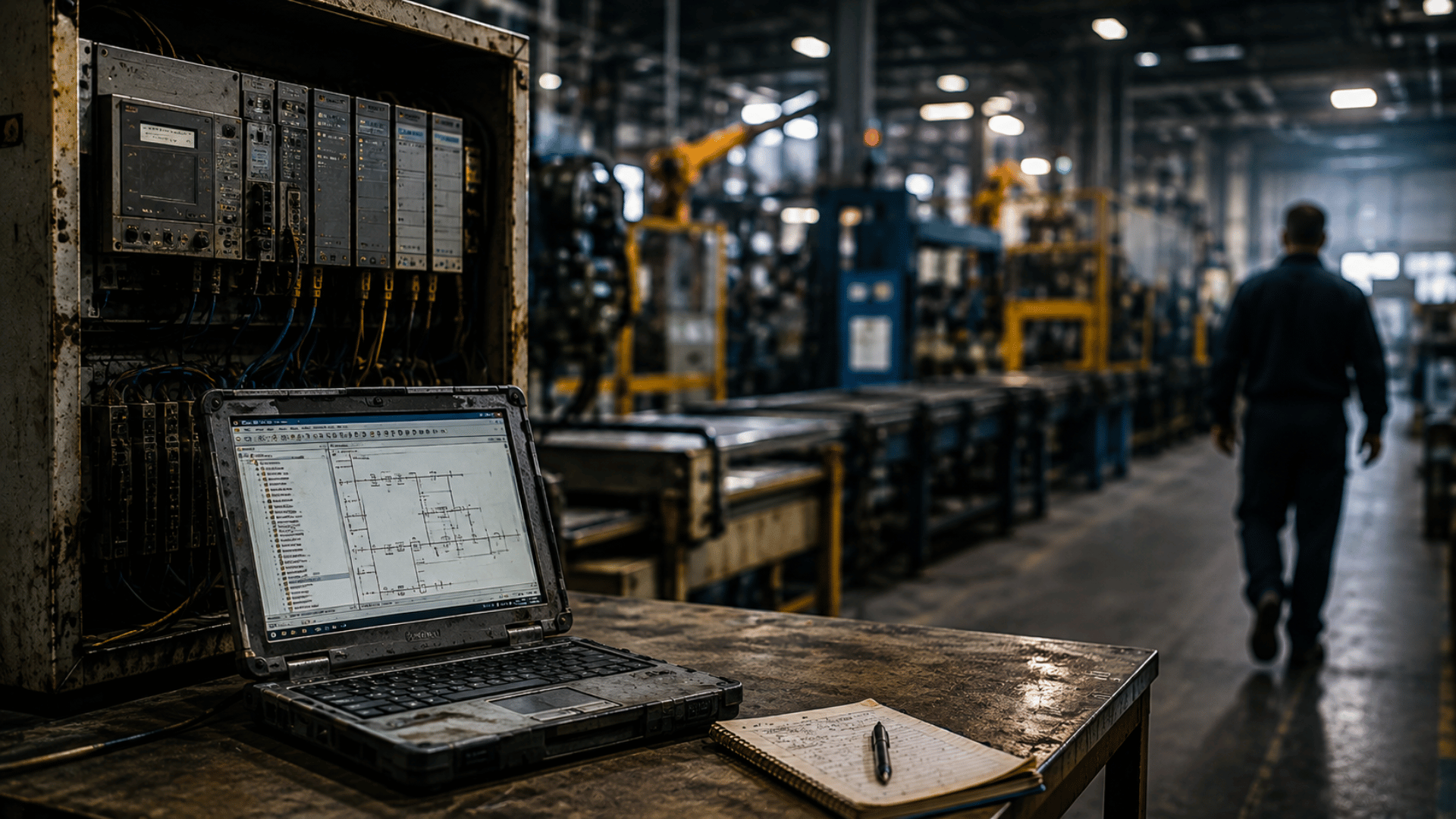

Learn how to prevent PLC integration failures by auditing legacy controls, verifying communication requirements, and identifying risks before equipment arrives, helping keep your manufacturing automation project on schedule and avoid costly commissioning delays.